In May 2020 the CAA purchased 2 AllSky7 cameras from AllSkyCams.
We need ACTIVE VOLUNTEER SUPPORT to carry out our mission ~ join us!
Our Charter: The CAA promote Science, Technology, Engineering, and Mathematics through astronomy. We do this by hosting free public programs, observing sessions and special programs available to community organizations, scouting, church groups, schools, universities and the general public. To be successful, we are dependent on the enthusiasm, energy and devotion of a cadre of volunteers from our surrounding communities.
If you want to help us with our mission, we will welcome you and find a way for you to help.
YOU DON’T NEED TO BE AN EXPERT TO FIND A MEANINGFUL AND FULFILLING ROLE WITH THE CAA!
And - it is a wonderful opportunity to learn!
Benefits of Volunteering With US:
∙ Have fun.
∙ Learn exciting new information.
∙ Challenge yourself.
∙ Meet new people and make new friends.
∙ Help others discover and learn.
∙ Contribute to STEM education.
Volunteer Roles:
∙ A variety of opportunities to volunteer exist - every interest, situation, skill level.
∙ Some are people-contact related, such as helping with group activities.
∙ Other tasks can be done without public contact - construction tasks to managing magazine subscriptions.
∙ If you are dependable and interested in our work, we will try to find a way for you to become involved.
∙ The belief that you must be an astronomy expert to volunteer is not true.
Times and Settings:
We will try to accommodate your various schedule and location needs:
∙ On-site, or remotely.
∙ Daytime as well as nighttime roles.
∙ We have needs for support of sporadic, regular/ongoing, and one-time activities.
Training Will Be Provided:
You needn’t worry about whether you are qualified for a particular volunteer task. We don’t want you to feel uncomfortable, nor do we want you in a role that is not suitable. We will provide training as needed, including:
∙ Observing, mentoring or shadowing.
∙ Specific instruction.
∙ Other tasks require no training or skills at all, like assisting with “crowd control” of large groups or cleaning up after an event.
∙ If you already have relevant skills, we certainly welcome that, too.
∙ After you submit an application, a CAA member will consult with you about how we can best use your skills.
Online FAQ:
Find more detailed information in our Frequently Asked Questions About Volunteering at www.cedar-astronomers.org
CAA Membership:
While you need not be a member to volunteer, our membership fees are modest. We hope you may decide to increase your participation by adding your support as a member.
We need ACTIVE VOLUNTEER SUPPORT to carry out our mission ~ join us! Our Charter: The CAA promote Science, Technology, Engineering, and Mathematics through astronomy. We do this by hosting free public programs, observing sessions and special programs available to community organizations, scouting, church groups, schools, universities and the general public. To be successful, we are dependent on the enthusiasm, energy and devotion of a cadre of volunteers from our surrounding communities. If you want to help us with our mission, we will welcome you and find a way for you to help. YOU DON’T NEED TO BE AN EXPERT TO FIND A MEANINGFUL AND FULFILLING ROLE WITH THE CAA! And - it is a wonderful opportunity to learn! Benefits of Volunteering With US: ∙ Have fun. ∙ Learn exciting new information. ∙ Challenge yourself. ∙ Meet new people and make new friends. ∙ Help others discover and learn. ∙ Contribute to STEM education. Volunteer Roles: ∙ A variety of opportunities to volunteer exist - every interest, situation, skill level. ∙ Some are people-contact related, such as helping with group activities. ∙ Other tasks can be done without public contact - construction tasks to managing magazine subscriptions. ∙ If you are dependable and interested in our work, we will try to find a way for you to become involved. ∙ The belief that you must be an astronomy expert to volunteer is not true. Times and Settings: We will try to accommodate your various schedule and location needs: ∙ On-site, or remotely. ∙ Daytime as well as nighttime roles. ∙ We have needs for support of sporadic, regular/ongoing, and one-time activities. Training Will Be Provided: You needn’t worry about whether you are qualified for a particular volunteer task. We don’t want you to feel uncomfortable, nor do we want you in a role that is not suitable. We will provide training as needed, including: ∙ Observing, mentoring or shadowing. ∙ Specific instruction. ∙ Other tasks require no training or skills at all, like assisting with “crowd control” of large groups or cleaning up after an event. ∙ If you already have relevant skills, we certainly welcome that, too. ∙ After you submit an application, a CAA member will consult with you about how we can best use your skills. Online FAQ: Find more detailed information in our Frequently Asked Questions About Volunteering at https://www.cedar-astronomers.org/files/Documents/FAQ.pdf CAA Membership: While you need not be a member to volunteer, our membership fees are modest. We hope you may decide to increase your participation by adding your support as a member. Volunteer
EVENT CALENDAR
The following calendar is a collection of astronomical events of importance provided by the New York Times. The observatory will not be open for all "events" listed, however we will update the CAA main webpage to indicate when the observatory is open for public visits.
Last updated: 2018-03-03
Choose a membership level.
StarDate Bi-Monthly Annual Subscription ($18.00)
Astronomy Magazine Monthly Annual Subscription ($34.00)
Sky and Telescope Magazine Monthly Annual Subscription ($32.95)
When finished, click view cart to checkout.
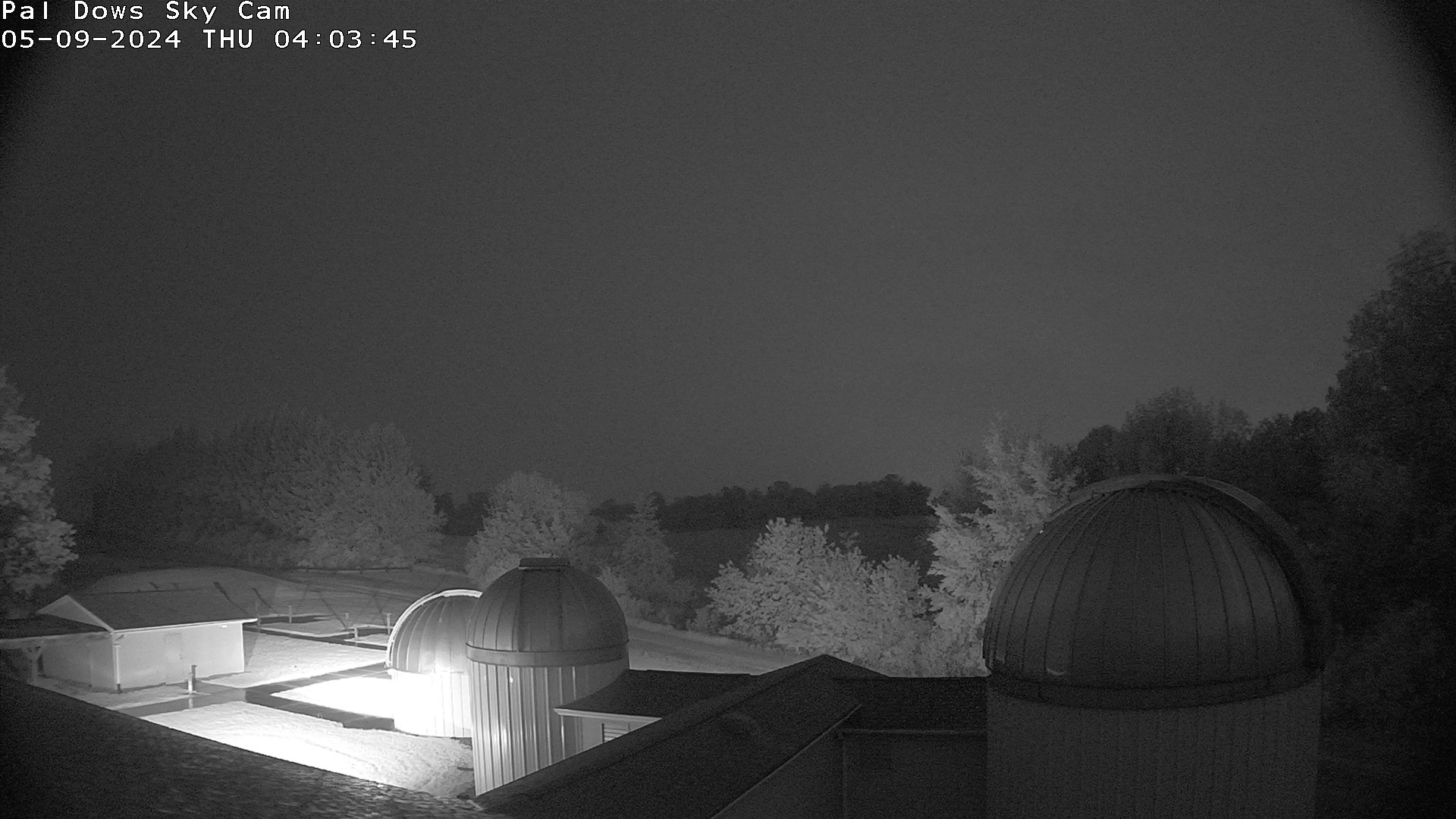
A view from the roof of the EIOLC.
Right click on image and open in new tab to get a larger image.
All Sky Imager at the EIOLC
Right click on image and open in new tab to get a larger image.
SRI International research scientist Dr. Asti Bahtt with the SRI MANGO network camera on the roof of the EIOLC on November 15, 2015. The Mid-latitude All-sky-imaging Network for Geophysical Observations (MANGO) employs a combination of two powerful optical techniques used to observe the dynamics of Earth's upper atmosphere: wide-field imaging and high-resolution spectral interferometry. Both techniques observe the naturally occurring airglow emissions produced in the upper atmosphere at 630.0- and 557.7-nm wavelengths. Instruments are deployed to sites across the continental United States, providing the capability to make measurements spanning mid to sub-auroral latitudes. The current instrument suite in MANGO has six all-sky imagers (ASIs) observing the 630.0-nm emission (integrated between ∼200 and 400 km altitude) – the camera stack shown installed here is one of those. Plus six ASIs observing the 557.7-nm emission (integrated between ∼90 and 100 km altitude), and four Fabry-Perot interferometers measuring neutral winds and temperature at these wavelengths. The network makes unprecedented observations of the nighttime thermosphere-ionosphere dynamics with the expanded field-of-view provided by the distributed network of instruments.
The network, and the data obtained, is in the public domain because it is all a result of contracts with the National Science Foundation (NSF) and SRI International is a non-profit organization. You can find links to the data and near-realtime video clips from the following compilation of site data:
https://www.mangonetwork.org/mango/v1/
In particular, the following link allows you to select a video clip of the previous night’s data from the Eastern Iowa Observatory (EIO) All Sky Imager (ASI). Use the calendar to select a night and view the result obtained by combining a processed image every 4 minutes into a video.
https://www.mangonetwork.org/mango/v1/database/sites/eio/redline/
A scientific paper published in 2023 by Dr. Bahtt et al with relevant information about the network of imagers, the data obtained, and some of the findings obtained from the network over several years is available at the following link:
https://agupubs.onlinelibrary.wiley.com/doi/full/10.1029/2023JA031589
The Eastern Iowa All Sky meteor camera network
The CAA operates 3 AllSky7 cameras in Eastern Iowa. One of the cameras is located on the roof of the EIOLC, another in North Linn Count and one in LeGrand Iowa. Each camera contains 7 image sensors that cover the entire sky. The cameras operate 24/7 and record the sky in both HD and SD resolutions. Software in camera control computers analyzes the night time video and detects any meteors seen. Having multiple cameras allows the trajectory of a detected meteor to be calculated and possibly it's orbit in the solar system before it entered the earth's atmosphere. Other interesting phenomenon have been recoded by the cameras,such as sprites and aurora. Sprites are a large-scale electrical discharge that appears as a red glow above thunderclouds. You can see video of some of these things on the Cedar Amateur Astronomers YouTube channel.
https://www.youtube.com/watch?v=IKBKN7a1Wf0
You can see live views from the three cameras in the Eastern Iowa All Sky meteor camera network here:
https://allsky7.net/index.html?&country=US-IA#liveview
A live view from the CAA AllSky7 camera looking North East
More Articles...
Subcategories
Please consider donating to the CAA
The CAA is on Facebook!
CAA YouTube Channel


